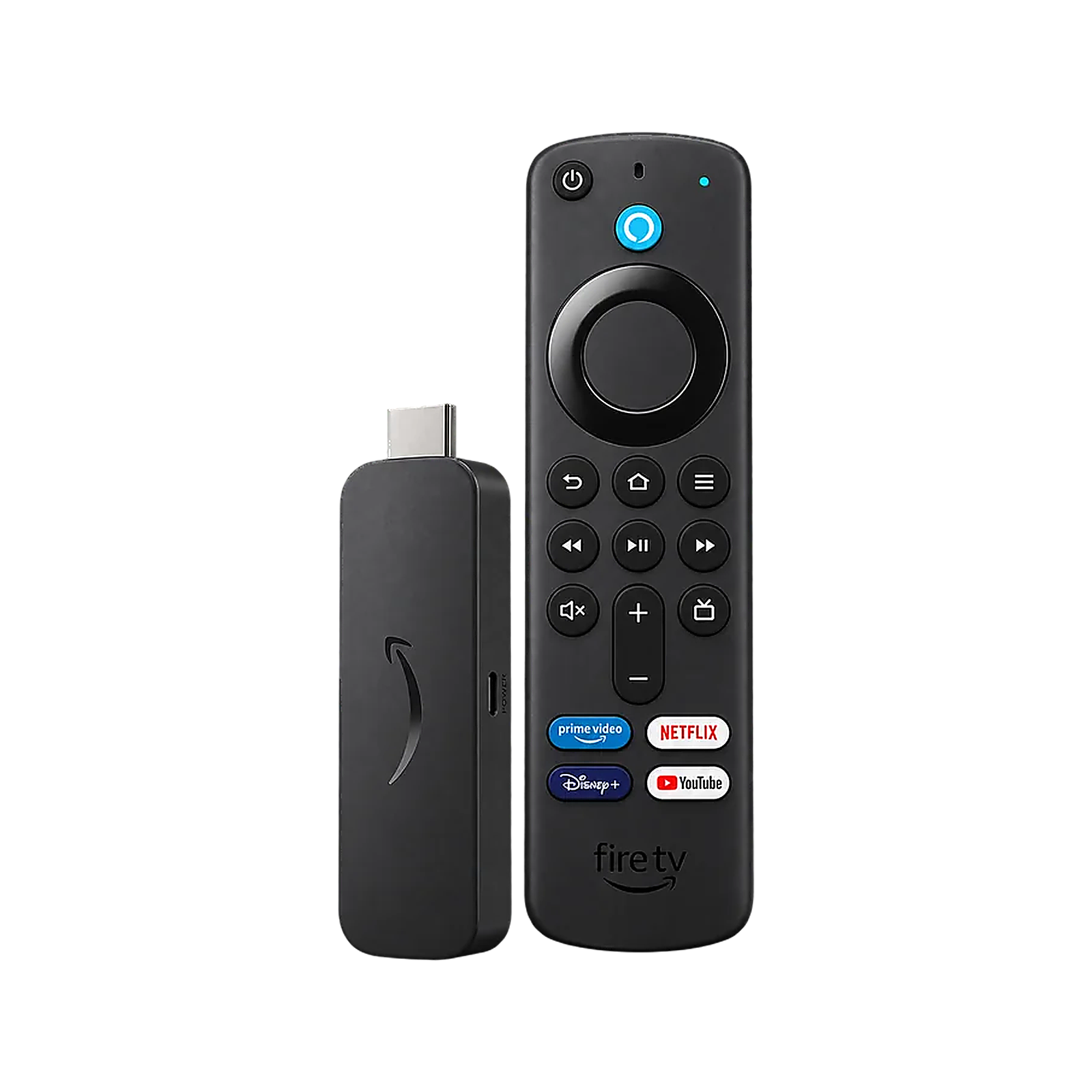
The second-generation Fire TV Stick 4K Max launched in 2023, so by 2026 it is no longer new hardware. That does not automatically make it outdated. Amazon still lists it in the current Fire TV device specifications, and its 16GB storage, Wi-Fi 6E and Fire OS platform continue to distinguish it from cheaper sticks in the range.
We haven't physically tested this exact retail unit, so this review is based on Amazon’s current specifications, platform documentation and its position against the other Fire TV devices in the current UK catalogue.
Fire TV Stick 4K Max: key specifications
| Feature | Fire TV Stick 4K Max (2nd Gen) |
|---|---|
| Release generation | 2nd Gen (2023) |
| Operating system | Fire OS 8, Android 11 base |
| Processor | MediaTek MT8696T, quad-core Cortex-A55 up to 2.0GHz |
| RAM | 2GB LPDDR4 |
| Storage | 16GB |
| Wi-Fi | Wi-Fi 6E, tri-band 2.4GHz / 5GHz / 6GHz |
| 4K | Yes |
| HDR | HDR10, HDR10+, HLG, Dolby Vision |
| Audio | Dolby Atmos support plus broad passthrough support |
| Built-in Ethernet | No; adapter required |
| Best for | Main TVs, larger app libraries and Amazon/Alexa households |
Why the 4K Max still stands out in 2026
The most useful advantage is 16GB storage. Many streaming sticks advertise 8GB, but the operating system, updates, apps and cached data all consume part of that space. Doubling the headline capacity gives the Max substantially more breathing room for a larger app library and future updates.
The Max also uses a faster 2.0GHz Cortex-A55 CPU configuration than Amazon’s mainstream 4K Plus, while retaining 2GB RAM. Raw specifications do not tell the whole story, but the combination makes the Max the safer Fire TV stick for heavier everyday use.
Fire OS 8 is an advantage if app flexibility matters
The 4K Max runs Fire OS 8, which Amazon documents as Android 11-based. That is increasingly important because not every new Fire TV stick uses the same operating system.
The cheaper Fire TV Stick 4K Select runs Vega OS instead. Vega is a separate platform and does not use normal Android APK packages. By contrast, the Android foundation of Fire OS gives the 4K Max a more established app ecosystem and broader legitimate app-installation flexibility, subject to Amazon’s current settings and platform policies.
If that distinction matters to you, see our Fire TV Stick 4K Select vs 4K Max UK comparison.
16GB storage is the Max’s clearest everyday advantage
Amazon specifies 16GB storage for the 4K Max, compared with 8GB on the 4K Plus and 4K Select. You do not get the full headline capacity as usable space, but the extra room matters if you install lots of streaming, utility or media apps.
If you mainly use five or six major services and rarely install anything else, the storage advantage becomes less important. In that case, the Fire TV Stick 4K Plus may offer better value.
Wi-Fi 6E: useful, but not essential for 4K
The Max supports Wi-Fi 6E across 2.4GHz, 5GHz and 6GHz bands. With a compatible Wi-Fi 6E router, the additional 6GHz band can provide a cleaner connection in congested homes.
You do not need Wi-Fi 6E simply to stream 4K video. A stable Wi-Fi 5 or Wi-Fi 6 connection can already provide enough bandwidth. Treat Wi-Fi 6E as useful networking headroom rather than a reason by itself to replace a working streaming device.
Picture and audio support remains strong
Amazon lists support for Dolby Vision, HDR10, HDR10+ and HLG, so the Max covers the main HDR formats used by current TVs and streaming services. Dolby Atmos is also supported, along with a broad range of audio passthrough formats.
That makes the Max particularly suitable for a main 4K TV where you want the streaming stick to take advantage of premium picture and audio formats. The cheaper 4K Select, by comparison, does not include Dolby Vision.
What is the Fire TV interface like?
The biggest non-hardware compromise is the Fire TV interface. It is closely tied to Amazon’s content, recommendations, Alexa and advertising ecosystem. People already using Prime Video, Alexa speakers and other Amazon services may find that integration convenient.
If you prefer a cleaner interface or Google’s ecosystem, compare Google TV vs Fire TV UK. Roku is another simpler alternative covered in our Roku vs Fire TV UK comparison.
Does it have Ethernet?
There is no built-in Ethernet port on the stick. Amazon lists Ethernet support through an external adapter. If a wired network connection is a priority and you do not want an extra dongle, a full streaming box can be a better form factor. See our best streaming devices with Ethernet UK guide.
Fire TV Stick 4K Max vs 4K Plus
The Max and Plus both run Fire OS 8 and have 2GB RAM, but the Max is the higher-specification model. It doubles storage from 8GB to 16GB, increases the CPU ceiling, and moves from Wi-Fi 6 to Wi-Fi 6E.
For a main TV or a larger app library, the Max is the better long-term choice. For lighter use, the Plus can be the smarter buy when the price gap is large. See the full Fire TV Stick 4K Max vs 4K Plus UK comparison.
Fire TV Stick 4K Max vs 4K Select
This is a much bigger difference. Select uses Vega OS, 1GB RAM, 8GB storage and Wi-Fi 5, and it omits Dolby Vision. The Max uses Fire OS 8, 2GB RAM, 16GB storage, Wi-Fi 6E and Dolby Vision.
If you simply need mainstream apps on a secondary television, Select can be enough when it is substantially cheaper. For a primary television, the Max is the much stronger device.
Who should buy the Fire TV Stick 4K Max?
- People choosing a Fire TV stick for their main television.
- Amazon and Alexa households that want the strongest Fire TV stick.
- Buyers who install enough apps to benefit from 16GB storage.
- People with Dolby Vision-compatible televisions.
- Homes with Wi-Fi 6E routers or congested wireless networks.
- Users who prefer the established Fire OS app ecosystem over Vega OS.
When to look elsewhere
- Light users who can save significantly by buying the 4K Plus.
- People who actively dislike Amazon’s content-heavy interface.
- Buyers who need built-in Ethernet or extra physical ports.
- Anyone better served by Google TV, Roku or Apple TV integration.
Our take
The Fire TV Stick 4K Max remains the best Fire TV stick for buyers who want capability rather than the lowest price. Its 2023 hardware is no longer new, but 16GB storage, 2GB RAM, Wi-Fi 6E, Dolby Vision and Fire OS 8 still give it a meaningful advantage over Amazon’s cheaper sticks.
If the price difference to the 4K Plus is small, buy the Max. If the gap is large and your app usage is light, the Plus is the value choice. The 4K Select belongs in a different category: it is a lower-cost Vega OS device for simpler mainstream streaming.
See the Fire TV Stick 4K Max device verdict, browse our best streaming sticks UK guide, or use the ViewHarbour Device Finder to rank the full catalogue around your priorities.